AI Buildcon runs multiple active job sites as an EPC general contractor, high subcontractor cost pressure, hard schedule risk, and procurement data that had never once been asked to answer a question.
The situation
Every EPC firm managing multiple active sites runs on the same quiet assumption: that procurement spend is under control because someone, somewhere, is checking it. At AI Buildcon, that assumption was doing a lot of unpaid work.
The firm's procurement data lived inside its ERP the way it does at most mid-size EPC firms scattered across formats, currencies, and suppliers, never standardized, never something anyone could actually query. Ask a simple question - which subcontractor's invoices spike in month three of a job, or which supplier's pricing has drifted furthest from the original PO and the honest answer was: nobody could tell you quickly, and most people wouldn't try.
Invoices were checked against purchase orders by hand. That's a defensible process when volume is low and every job looks like the last one. It stops being defensible the moment a firm is running several active sites at once, each with its own subcontractor list, its own change orders, its own pace of billing. There was no systematic way to catch a duplicate invoice or a PO mismatch before the payment went out only ever after, if at all. Leakage didn't show up on a dashboard in anything close to real time. It showed up, if it showed up, in a reconciliation months later, disconnected from the job it came from.
Supplier risk was a judgment call, not a measurement. Relationship and reputation carried real weight they usually do, and for good reason but they're not the same thing as evidence, and they don't scale across a growing subcontractor base the way a general contractor with cost pressure on every job actually needs them to.
And then there was the knowledge that never made it into any system at all. A site visit happens. An owner meeting happens. A handover happens. Whatever mattered from that hour lived in the head of whoever was in the room, and stayed there unless that person happened to write it up which, on a busy job site, is not the way to bet. No structured capture, no trail for the next engineer, no way to search back through what was actually said three site visits ago.
None of this made AI Buildcon unusual. It made it a mid-size EPC firm managing exactly the cost pressure and schedule risk the industry runs on with tools that hadn't caught up to the job.
What Scorpio did
Scorpio started where every real fix has to start: the data. Agents don't reason well over spend data that's fragmented across formats and never standardized, so the first move wasn't a dashboard it was a foundation.
Standardized the foundation. Raw ERP and BOQ procurement spend was cleansed into a single, consistent, queryable base the layer every other agent in the deployment now reasons over. Everything downstream depends on this holding.
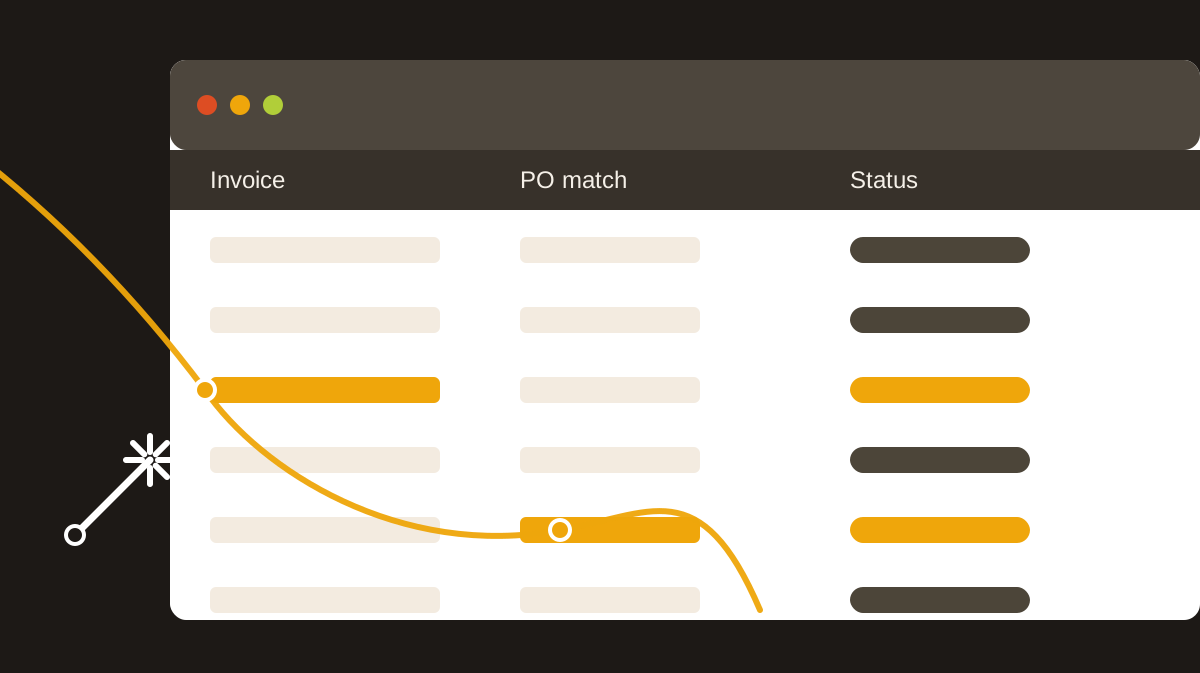
Scored every invoice before it was paid, not after. Each invoice now runs through an agent-driven confidence-scoring model, checked directly against its originating purchase order. Duplicates and mismatches get flagged before payment goes out moving the catch from a reconciliation exercise to a control at the point it actually matters.
Replaced the manual-audit cadence with a live view. Leakage, duplicate invoices, and spend anomalies now surface on dashboards built on the cleansed data, as they occur not on whatever cycle the last manual audit happened to run on.
Connected two data sources no manual process had ever put in the same room. Supplier risk scoring reasons across AI Buildcon's own internal performance and payment history alongside external, web-sourced signals on each supplier, and synthesizes both into a single score. That's not a faster version of the old relationship-and-reputation call it's a different kind of answer entirely, built from evidence a manual process was never going to assemble on its own.
Turned field knowledge into a structured record automatically. The moment a site visit or an owner meeting ends, the raw capture is turned into a structured report tagged by site, routed to the people who need it with no one sitting down afterward to write it up from memory. What used to live only in whoever attended now has a trail.
Two pillars, one deployment: the procurement intelligence agents work the invoice-to-risk chain, and the field-capture agent works the knowledge that used to evaporate the moment a meeting ended. Both were built to reason over the same governed data foundation, so a supplier risk signal and a site-visit note about that same supplier aren't sitting in two different systems that never talk to each other.
Where it stands today
The procurement and field-capture agents are both running in production on AI Buildcon's active sites not a pilot, not a proof of concept sitting in a sandbox waiting for sign-off. This is how the firm runs its sites now.
AI Buildcon's leadership has said plainly that Oraczen is helping the firm finally understand its contractor spend. That's the first tangible outcome of the procurement layer landing, and at this stage of the deployment, it's the one that matters most: for the first time, the firm can see what it's spending, on whom, and why instead of trusting that someone, somewhere, was keeping track.
As the deployment matures, the value compounds in the direction you'd expect from a firm managing multiple active sites at once: fewer invoices slipping through without a check, supplier risk scores that update as new signals come in rather than sitting stale until the next relationship review, and a field-knowledge trail that survives staff turnover and job handovers instead of walking out the door with whoever was in the room.