Why Adopt a Platform-Based Approach to Generative AI for Enterprise Success?
Raghavendra Prasad
•
Nov 15 2024

Deepa Krishnan
•
Oct 7 2026
Supplier risk signals are only useful when they lead to clear action. This article explains how to turn supplier risk signals into practical playbooks, define triggers and owners, set default actions, and bring exposure and decisions together in one clear view.
A supplier risk alert lands in a shared inbox. Everyone sees it. No one is sure whose call it is, what it is worth, or what to do first.
That is not a supplier risk monitoring problem. It is a missing supplier risk playbook and a missing risk briefing. This guide covers both: the action playbook that decides what happens when a signal fires, and the supplier risk briefing that puts the right facts in front of the right person.
McKinsey's 2025 Supply Chain Risk Pulse found that 95% of respondents have visibility into tier-one supplier risks, but only 42% have it into tier two or beyond. That gap in multi-tier supplier risk visibility is where supplier disruption tends to start.
Resilinc's 2026 NAPES polling adds the response side: 81% of organizations still rely on manual or traditional approaches to mitigate disruptions.
Supplier risk intelligence AI can surface signals faster. A signal still needs a path to a decision. A playbook fixes the path, and a briefing makes sure the decision-maker sees what matters. Both build on the five-stage workflow of signal, exposure, scenario, owner, and response.
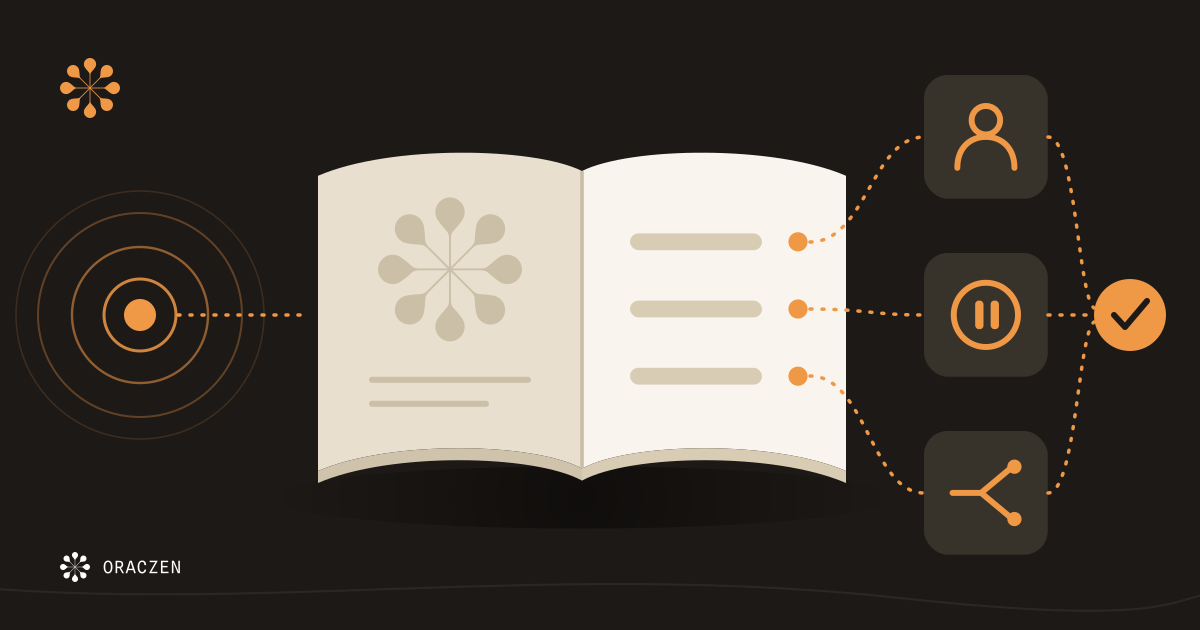
A supplier risk playbook is a set of decisions made in advance, so no one has to make them during a disruption. It has four parts.
List the signals that warrant action and the threshold for each. A suspended GSTIN is a trigger. An expired FSSAI license for a food supplier is a trigger. A court filing is a trigger. Agreeing these in advance means supplier risk management follows data, not relationship proximity.
Give every trigger one question: what does this cost right now? Open purchase orders, input tax credit tied to the supplier's filings, and single-source dependency usually answer it.
Map each trigger to one named role, not a shared function. Procurement owns the relationship, finance owns tax credit, quality owns licenses. Where two r
oles share a trigger, name a lead.
The options are few: escalate, hold purchase orders, enforce a contract clause, activate an alternate supplier, or formally accept the risk. Pick a default for each trigger. Owners can override it with a recorded reason, so the playbook sets the starting point rather than the final word.

The difference shows up the first time a critical supplier changes status.

The supplier risk briefing is the one-page view that owners and leadership actually read. Keep it short, ranked, and decision led.
Open with what is at stake, ranked by value. An alert count tells a leader nothing. “Input tax credit at risk across four suppliers” does.
Report movement since the last briefing: new signals, resolved ones, and exposure that grew. A static snapshot hides the trend.
Close with the specific calls waiting on a named owner, each with a recommended response and the evidence behind it. A briefing that ends in a summary invites no action.
Because supplier risk monitoring runs continuously, the briefing can support real-time decisioning for critical triggers instead of waiting for a monthly review.
Scorpio, an agentic AI procurement platform, runs the Supplier Risk Analysis Agent, SRA, to feed both. SRA monitors GSTIN status, GSTR-2A and GSTR-2B reconciliation, MCA and ROC filings, NCLT proceedings, and FSSAI license status continuously, and quantifies ITC exposure, so each trigger arrives with its exposure check attached.
Findings sit on a canonical supplier record built by the Data Enrichment Agent, so one supplier is one record, not three. Scorpio connects to existing ERP systems such as SAP, Oracle, and Microsoft Dynamics through ERP integration, without replacing them.
SRA ranks each finding and explains the evidence behind it, which keeps every line in the briefing traceable to source data. A human owner reviews the recommendation and decides, a human-in-the-loop model. As trust builds, routine responses can move toward human-supervised, without removing the human from high-stakes calls.
A supplier risk signal without a playbook is awareness without a plan. A playbook without a briefing is a plan no one sees. Set the triggers, name the owners, agree the defaults, and put exposure and decisions on one page.