
Scorpio
Enterprise agentic procurement
Spend intelligence, supplier data and contract compliance across federated ERP estates.
Explore Scorpio
We built two enterprise-grade agentic systems.
We can build yours.
What we build
Customer, employee and operational agents that understand enterprise context, use tools and take action.
Turn multi-step business processes into intelligent workflows that reason, act and involve people where judgment matters.
Build new AI-native products, or embed intelligence into the software, platforms and experiences your customers already use.
Use AI-assisted engineering to understand, re-architect and rebuild critical legacy applications while preserving the business logic they contain.
POC to production
A demo can take weeks. Building an AI system your enterprise can depend on is harder.
We solved these problems building Scorpio and Auron. Now we bring that engineering experience to yours.
Built twice already
Enterprise agentic procurement
Spend intelligence, supplier data and contract compliance across federated ERP estates.
Explore ScorpioEnterprise agentic customer engagement and selling
Voice and chat agents that engage, qualify and sell, grounded in the enterprise systems of record.
Visit useauron.aiWhat building them required
Building and operating these systems meant solving the same production problems our customers meet: context, data, orchestration, evaluation, security, integrations, observability, token economics and model selection.
Enterprises running on systems this team built




2-2-2 Methodology
An iterative way to align on the use case, and to fail fast if it is the wrong one.
Understand the problem, outcome and stakeholders.
Map the workflow, users, data, architecture, security and success criteria.
Build enough to prove the use case, the architecture and the path to production.
What you can answer afterwards
Is this the right use case?
What should we buy versus build?
What should we own?
What common architecture and controls will we need?
What is the path from POC to production?
How we work
Where agentic AI pays.
The system, and the context layer beneath it.
Integrations, agents, workflows.
Evals engineered in, not bolted on.
Identity, access, policy, audit.
Into production, on infrastructure you trust.
Performance and token economics at scale.
The objective is not another AI pilot.
It is a system your enterprise can trust, operate and scale.
AI engineering capabilities
Agentic AI development, LLM engineering and the platform work underneath: the disciplines it takes to move an enterprise AI system from prototype to production.
Emerging practice
Partnerships
Claude Partner Network
An Anthropic partner, with production systems built on Claude. Anthropic models run inside Scorpio and Auron today, and both were built with Claude Code.
A differentiated service
Generating new code is becoming easier. Understanding what the old system actually does, and proving the new system preserves what matters, is still engineering.
Six stages, end to end
Read the estate as it is: what runs, what is dead, what nobody dares touch.
Dependency graphs and data flows across modules documented once, years ago.
Recover the business logic buried in the code, most of it written down nowhere. This is where a rebuild is won or lost.
Design the target: what becomes a service, what becomes an agent, what stays strictly deterministic.
Rebuild, with equivalence tests proving the new system behaves as the old one did where it matters.
Wrap it in the controls that make a business willing to cut over.
Claude Code accelerates understanding and transformation across a codebase larger than any team could read. Oraczen engineers supply the architecture, the business-rule recovery, the equivalence testing, the security and the production hardening.
Claude Code runs inside your own estate: Amazon Bedrock in your VPC with private endpoints, Google Vertex, Microsoft Foundry, or your own keys. Your source never has to leave.
Hardened with reusable capabilities
Built once as shared services, so every rebuilt application and every agent inherits them instead of reinventing them. Models and tools accelerate the rebuild; enterprise engineering decides whether the organization can safely cut over.
On why that control layer decides the outcome, see Why The Harness Matters More Than The Model — YC Paper Club
Adjacent, and already in production: standardizing a fragmented ERP estate into a queryable foundation, then putting agents on top of it.
Real-time procurement intelligence and field capture for EPC contractorsAn EPC contractor
Our point of view
Harness design, and where the boundary between buying and owning should sit.
Anatomy of an agent, and the dimension the market under-serves
A reference architecture, and which layer has to stay yours
Buy agents without buying their architecture
A twelve-statement readiness checklist
Cloud infrastructure
Systems built on AWS, with Bedrock and the surrounding services as the runtime. We do not rebuild the substrate; the differentiated engineering sits above it.
Sovereignty
Your models will change. Your enterprise intelligence should remain yours.
Enterprise data stays governed on your terms.
Your knowledge, memory and business context remain enterprise assets.
Use the best proprietary models today, and open models where they offer better control, economics or deployment flexibility.
Identity, access, orchestration, evaluation and audit remain independent of any single model or provider.
Use the best models. Own the intelligence. Control the future.
Proof and trust
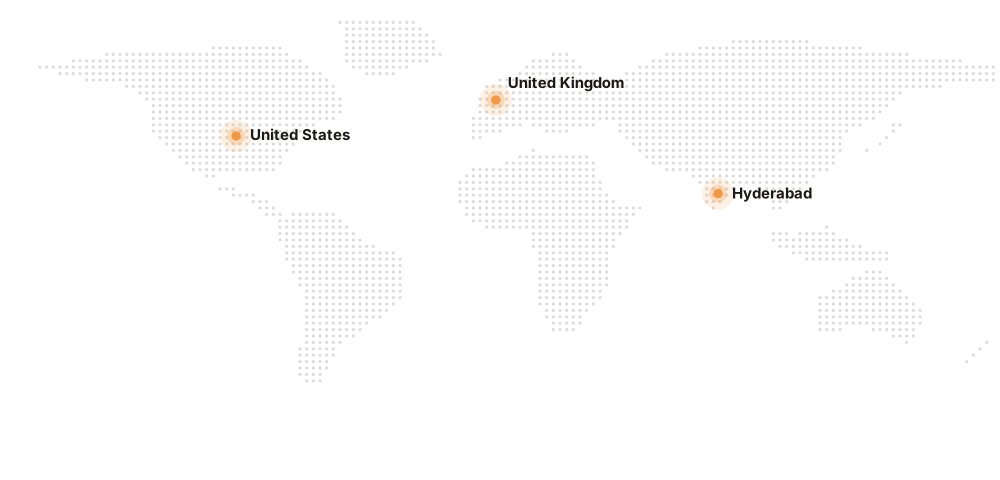
United States · United Kingdom · India
Customer-facing and forward-deployed engineering in the US and UK, backed by deep product and AI engineering capability in India.
Certified, partnered and recognized

Independently audited security, availability and confidentiality controls, with an on-premise option where data cannot leave your estate.
Recognition




Industries
Regulated agentic systems where entitlements and a complete decision trace are requirements.
Spend intelligence and supplier data across federated ERP estates.
Sourcing, contract compliance and supplier risk, agent-operated.
Engagement and selling agents grounded in the systems of record.
Production and distribution workflows on agentic infrastructure.
Contract and supplier governance across large subcontractor networks.
Engineering, Procurement & Construction (EPC)
AI Buildcon runs multiple active job sites as an EPC general contractor, high subcontractor cost pressure, hard schedule risk, and procurement data that had never once been asked to answer a question.
Read the story
Procurement, Supply Chain
A diversified enterprise specializing in food products has a decades-long legacy of driving innovation across agriculture, food technology, and industrial applications. With a global manufacturing and distribution footprint and a workforce of over 10,000, the company partners with enterprises across consumer goods, health sciences, and industrial sectors to co-develop high-performance, nature-derived products.
Read the story
Procurement / Finance
A Fortune Global 500 manufacturer with $15 billion in annual revenue faced a persistent procurement challenge: millions of annual transactions had to be classified across multiple taxonomies with high accuracy, speed, and compliance. Inconsistent naming, free-text purchase descriptions, and decentralized procurement structures made reliable classification difficult to scale. Manual processes consumed 12,000 hours annually and delivered a 20% misclassification rate. PSA, an agentic system built on Oraczen’s Zen Platform, deployed an AI-driven classification capability combining machine learning, Retrieval-Augmented Generation (RAG), large language models (LLMs), and human-in-the-loop (HITL) oversight. The result: 95% classification accuracy, 85% time savings, and $30 million in identified cost-saving opportunities.
Read the storyQuestions
We have built two already. Let's build yours.